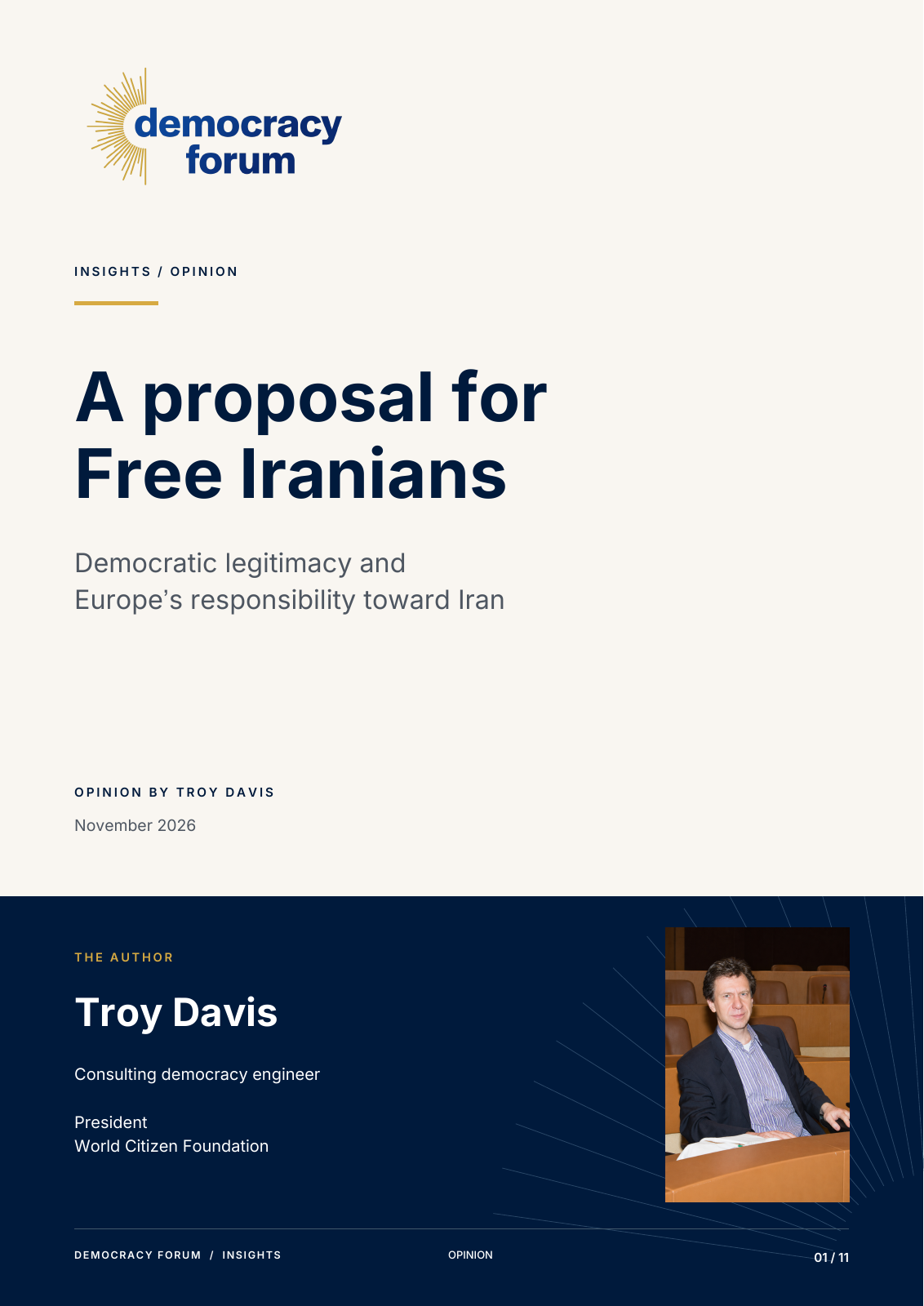
Troy Davis — Consulting democracy engineer; President, World Citizen Foundation
A prize for the Iranian people
On 7 November 2026, the Friedrich Naumann Foundation for Freedom awarded its Freedom Prize to the Iranian people in Frankfurt’s Paulskirche, a symbol of Germany’s democratic history since 1848. Because the Iranian people cannot yet send freely elected representatives, Reza Pahlavi received the award in trust until it can be handed to representatives chosen through a free democratic process. The distinction belongs to the Iranian people. [1]
The choice of Pahlavi has prompted a question: why him? In my view, he is a compelling choice for this responsibility. He is a prominent opposition figure with substantial support, and he has repeatedly stated that the Iranian people must choose their future political system. Receiving an award in trust is not, however, a substitute for the democratic mandate that only Iranians themselves can confer. [6]
That distinction brings us to the central issue. Iran lacks a freely elected government accountable to its people because of the political system imposed by the mullahs’ regime. Pahlavi did not create that system. His present proposals should therefore be assessed on their own terms, including his publicly stated commitment to secular government, equality before the law, individual freedoms and a free and fair vote on Iran’s future constitutional order. [2]
Whether Iranians choose a republic or a constitutional monarchy must be their decision. France and Germany demonstrate one constitutional tradition; Spain and Sweden demonstrate another. The essential democratic question is whether citizens can choose freely, enjoy equal rights and hold those who govern them accountable. Article 21 of the Universal Declaration of Human Rights places the will of the people at the foundation of governmental authority. [3]
A legitimate transition is also a practical necessity. After decades of repression, Iran needs to rebuild trust between citizens and public institutions. A process grounded in consent offers a stronger basis for cooperation and peaceful disagreement than one imposed from above. Legitimacy reduces the danger of political violence.
Europe’s post-war experience illustrates this principle. After centuries of conflict between France and Germany and two devastating world wars, Europeans helped build a durable peace through democratic cooperation grounded in popular legitimacy. The Council of Europe and its Parliamentary Assembly, established in 1949, were early milestones. The separate process of European integration later produced the world’s first directly elected supranational parliament, with the European Parliament’s first direct elections in 1979. [7] The same principles can guide other countries and regions.
European democracies should support the conditions in which that choice becomes possible. They should neither prescribe Iran’s constitutional future nor treat its people as incapable of deciding it. The Frankfurt award expresses solidarity with their freedom while leaving the ultimate political decision where it belongs: with the Iranian people.
Judge present commitments
Individual responsibility is a fundamental principle of liberal democracy. People should be judged for their own conduct, not held guilty for their parents’ actions. This applies to Reza Pahlavi, who was eighteen at the time of the mullahs’ takeover in 1979. His father’s political record cannot engage his personal responsibility.
The rejection of inherited guilt has deep religious roots. Deuteronomy 24:16 states that “neither shall the children be put to death for the fathers”; Ezekiel 18:20 adds: “The son shall not bear the iniquity of the father.” [11] The Qur’an states in verse 6:164: “No soul burdened with sin will bear the burden of another.” [12]
The secular roots are equally powerful. In Laws, Book IX, Plato proposed the general rule that “the disgrace and punishment of the father is not to be visited on the children”. [8] Kant called moral guilt “the most personal of all liabilities”. [9] These are foundational voices in Europe’s own intellectual heritage.
Here in Germany, Karl Jaspers’s Die Schuldfrage (1946) is especially relevant. He writes: “Only the individual can be punished for crimes.” [10] The implication is clear: criminal guilt is not inherited by later generations. His distinction between individual criminal guilt and political responsibility leaves room for later generations’ responsibility to remember the past and prevent future crimes.
When European politicians and media treat ancestry as guilt, they betray the religious and philosophical heritage they claim to cherish. They should apply its principles to Iranians with the same conviction they expect at home.
This does not diminish historical scholarship, victims’ testimony or scrutiny of the Pahlavi monarchy. Understanding that history differs from treating a family connection as a verdict on present conduct. Nor must a future role for Pahlavi reproduce the government of his father. The world is different today: more open, democratic and connected. Pahlavi’s declared position and Iranians’ choices are different. Reconstruction would require public trust and cooperation across a diverse society.
The practical questions concern rights, public consent, freedom for opponents to organise and citizens’ ability to reject a leader or constitutional settlement. Pahlavi’s commitments should face the same scrutiny as those of every contender. No individual can guarantee democracy; it must be built, sustained and defended. A fair hearing means judging his actions and proposals while keeping attention on the repression exercised by the mullahs’ regime today.
Apply the same principles
European leaders regularly affirm that freedom, human dignity and democratic participation are universal. Their response to Iran should make those principles visible in practice. When legitimate democratic aspirations outside Europe receive less support or less serious attention, the gap between declared values and political conduct becomes difficult to defend.
Democracy is learned through participation. It takes time to develop institutions, habits of compromise and confidence in public life. Europeans should remember the conflicts and failures through which their own political systems developed. The Iranian people should not be expected to demonstrate a fully functioning democracy before receiving support for the freedom necessary to build one.
The stakes are immediate. Amnesty International reports that security forces unlawfully killed thousands of protesters and bystanders on 8 and 9 January 2026. [4] Other documentation projects have published substantially higher estimates over different observation periods. [5] The figures and methods require careful attribution; uncertainty over the final total must not obscure the gravity of the violence.
Debates about events half a century ago should not displace scrutiny of present repression. The original question is not whether Iran’s past can be simplified into a favourable or unfavourable story. It is how citizens facing coercion today can exercise their rights, and how outside democracies can avoid strengthening the forces that deny those rights.
Syria shows how this works. Bashar al-Assad branded his opponents jihadists and himself a bulwark against them. His forces killed and tortured children from 2011, dropped barrel bombs on civilian neighbourhoods and imprisoned, tortured and executed opponents and innocent bystanders. [13] Russian aircraft later bombed Syrian cities. [14] In my view, Western acceptance of this false choice weakened the democratic alternative. In 2014, moderate opponents, out of sheer desperation at being abandoned by the West, defected to Jabhat al-Nusra, al-Qaeda’s Syrian affiliate. [15] Such outcomes reinforced Assad’s narrative. The lesson is concrete: abandoning democratic opponents can strengthen the extremists a dictator claims to resist.
In the Iranian debate, descriptions of opposition figures as simply royalist or reactionary can likewise substitute labels for examination. Journalists should investigate what these figures actually propose, how their supporters understand those proposals and what their critics can substantiate. The same standards should apply to claims made by the mullahs’ regime.
This is a demand for consistency, not immunity from criticism. European democracies can scrutinise Pahlavi, disagree with him and challenge his programme while recognising the Iranian people’s right to freedom. They should be equally willing to examine whether their own policies help citizens seeking democratic change or leave them isolated. Universal principles lose their meaning when their practical application depends on geography, religion or cultural familiarity.
Why Iran’s freedom matters
Iran’s political future matters far beyond its borders. Its regional influence and its relations with other authoritarian powers connect domestic repression with wider questions of war and peace. A democratic Iran could change those relationships and open possibilities for more peaceful cooperation. Supporting the Iranian people’s freedom is therefore both a matter of principle and a strategic concern for Europe.
The comparison with Ukraine is instructive. Ukrainians are resisting an external invasion today; Iranians seeking political freedom face repression rooted in an external invasion fourteen centuries ago. In both cases, people are struggling to determine their future without coercion. European support for Ukraine should encourage a more consistent understanding of the Iranian struggle, rather than make Iran seem remote or unrelated.
A democratic transition would not automatically resolve every dispute over weapons, regional security or nuclear energy. It will create a strong basis for accountable decision-making and international commitments. The deeper problem is the character of political power and its relationship with the population. Negotiations over individual security issues should not make the rights of that population disappear from view.
The peace dividend of a free Iran would begin with Iranians themselves: the ability to live, speak, organise and choose without political repression. Its wider significance would come from the relationships a more accountable government could build. That prospect warrants sustained attention from European policymakers and the media.
Learn from Europe’s history
The Frankfurt ceremony should be an occasion to ask better questions about Iran. The award honours a people whose struggle for freedom has endured over decades. Its significance should not be reduced to a dispute about the ancestry of the person receiving it in trust. The central question is how the Iranian people can become free to choose their own government.
For the media, that means examining the substance of the opposition’s proposals. What process is envisaged for a transition? How would citizens exercise their political sovereignty? How would a future government protect equality, freedom of conscience and the right to dissent? What evidence supports claims about political support? These are questions that can illuminate the choices ahead.
It also means investigating present repression with the same determination. Reports of killings, imprisonment and intimidation require documentation, careful verification and sustained attention. Conflicting estimates should be explained through their sources, time periods and methods. Journalistic caution about a number must not become indifference to the people behind it.
European leaders should examine whether their policies reflect the democratic values they profess. Engagement with governments may be necessary, but it should not become an assumption that authoritarian rule is permanent or that a population’s aspirations are secondary. The right to choose a political future belongs to Iranians as fully as it belongs to Europeans.
Together with Iranians who believe in the universal principle that all humans have equal rights, we must remind the West of its own values and ask its elites to recognise their mistakes. Europe’s intellectual history offers examples of both moral clarity and prolonged loyalty to oppressive regimes.
We ask Western elites to recover the critical independence of Albert Camus, Bertrand Russell and Edgar Morin, who challenged Soviet oppression and the orthodoxies used to excuse it. [16] Their example matters more than Jean-Paul Sartre’s years of accommodation with Soviet communism or the enduring Communist Party loyalties of Pablo Picasso and Louis Aragon. [17] The lesson is to acknowledge mistakes before loyalty to a political cause becomes an excuse for denying its victims.
Charles de Gaulle offers another lesson. In his Appeal of 18 June 1940, as France faced military defeat, he insisted: “This war is a world war.” His later proclamation, À tous les Français, declared: “Nothing is lost, because this war is a world war.” [18] He understood that a national defeat did not settle the outcome of a worldwide struggle. European leaders should recover that breadth of vision today.
Freedom is the central issue
In political terms, I believe we are in a world war between freedom and tyranny, between democracy and dictatorship. Dictators already act across borders: Iran and North Korea have provided military support for Russia’s war against Ukraine. [19] Western governments cannot afford to behave as if this were business as usual. Supporting people who seek democracy in their own countries is both a moral responsibility and a fundamental strategic interest of democracies.
Seen in the spirit of de Gaulle’s appeal, the Iranian struggle in January 2026 was part of this wider confrontation. ICDAN estimates approximately 54,200 protest-related deaths between 1 and 23 January. [5] I regard this “Battle of Iran” as more than a local tragedy: it belongs to the wider struggle between freedom and tyranny, just as the fate of Ukraine matters beyond Ukraine.
Dictatorships understand that we are in a world war and therefore eagerly cooperate with one another. Naive democracies do not understand this yet, so they unfortunately do not cooperate much, sometimes even menacing other democracies. We democracies must help all peoples struggling for freedom. Even though conflicts in Africa, Asia or Europe look different, they all share a common feature: authoritarian governments. As democracies today spend billions more in military spending, ostensibly to preserve democracy, international peace and security, we must realise that this can only be achieved if its root cause is eliminated: tyranny.
The real problem with Iran is neither missiles nor nuclear weapons.
The real problem is freedom and democracy.
That is why I argue that the only durable solution is regime change: ending theocracy and moving Iran from the camp of tyranny to the camp of democracy. Iranians themselves must determine the institutions that replace it. We are grateful to the Friedrich Naumann Foundation for recognising the Iranian people’s struggle through this award. [1]
Dictators cannot be relied upon as long-term guarantors of peace. Russia’s war against Ukraine illustrates the danger of assuming that agreements with authoritarian rulers will ensure lasting security.
A free and democratic Iran would transform the context of debates about missiles and nuclear energy. The new Iran we seek would honour its international commitments and make decisions about its armed forces and peaceful nuclear energy accountable to its citizens. That is the political foundation for lasting trust: a country whose government answers to its people and whose international promises are sustained by democratic institutions.
The same standard applies to Reza Pahlavi. I support taking his democratic commitments seriously and consider his role as trustee of this award justified. Those commitments should remain open to examination. Respecting his right to be judged as an individual and respecting the Iranian people’s sovereignty are compatible obligations.
Democracy is never a completed achievement. It depends on defending its principles when doing so is difficult or politically inconvenient. The Frankfurt award should help turn recognition into informed debate and sustained solidarity with the Iranian people’s freedom. Their democratic choice must remain the purpose of Europe’s support.
Sources
[1] Friedrich Naumann Foundation for Freedom
“Der iranische Oppositionspolitiker Reza Pahlavi nahm die Auszeichnung treuhänderisch entgegen.”
Ein Preis für ein ganzes Volk, 7 November 2026.
https://www.freiheit.org/de/pressemitteilung/ein-preis-fuer-ein-ganzes-volk
[2] Reza Pahlavi’s Toronto address
“Upholding the right of the Iranian people to choose their future system of government through a free and fair vote.”
Cyrus the Great II, Toronto, 19 September 2026.
https://rezapahlavi.org/en/events/speech-cyrus-the-great-ii-toronto-september-19-2026
[3] Universal Declaration of Human Rights
“The will of the people shall be the basis of the authority of government”.
United Nations, 1948, Article 21(3); see also Articles 1 and 2.
https://www.un.org/en/about-us/universal-declaration-of-human-rights
[4] Amnesty International on the January 2026 crackdown
“Iran’s security forces used firearms on an unprecedented scale and unlawfully killed thousands of protesters and bystanders.”
Why is Amnesty International calling for international justice for crimes against humanity in Iran?, 16 September 2026, section on the January massacres.
https://www.amnesty.org/en/latest/campaigns/2026/09/why-is-amnesty-international-calling-for-international-justice-for-crimes-against-humanity-in-iran/
Restrictions on information and access create serious obstacles to establishing a complete death toll. Those restrictions are entirely the responsibility of the mullahs’ regime.
[5] ICDAN assessment published by Democracy Forum
“Approximately 54,200 deaths as the principal nationwide estimate, applying a 10% under-ascertainment correction to the clinical component only”.
Parasta AM, on behalf of ICDAN. Updated Assessment of Protest-Related Deaths and Injuries in Iran: Validated Follow-Up Data and Conservative Nationwide Estimates. Observation period: 1–23 January 2026; data cut-off: 15 June 2026.
https://democracy-forum.org/en/news/icdan-report-protest-related-deaths-iran-2026
[6] GAMAAN survey on Iranian public attitudes
“Reza Pahlavi continues to receive positive evaluations from a substantial share of society”.
Ammar Maleki, Iranians’ Attitudes Toward the 2026 Protests and War, July 2026, survey summary, printed p. 3; fieldwork: 20–27 June 2026.
[7] European institutions and democratic legitimacy
Council of Europe Parliamentary Assembly, Origins and history: “On 5th May, 1949” the founding governments “signed in London the Statute of this new body, the Council of Europe.”
https://pace.coe.int/en/pages/brief-origins
European Parliament Historical Archives: “Since June 1979, EU citizens have directly elected Members of the European Parliament”.
[8] Plato on responsibility across generations
“the disgrace and punishment of the father is not to be visited on the children”
Laws, Book IX, translated by Benjamin Jowett.
https://classics.mit.edu/Plato/laws.9.ix.html
[9] Immanuel Kant on the personal character of guilt
“die allerpersönlichste, nämlich eine Sündenschuld, die nur der Strafbare, nicht der Unschuldige […] tragen kann.”
Die Religion innerhalb der Grenzen der bloßen Vernunft, Akademie 6:72, lines 19–22. English wording in the article follows George di Giovanni’s translation, p. 89: “the most personal of all liabilities”.
https://korpora.org/kant/aa06/072.html
[10] Karl Jaspers on individual criminal guilt
“Für Verbrechen kann je nur der einzelne bestraft werden”.
Die Schuldfrage (1946), Gesamtausgabe I/23, Schwabe, 2021, p. 41. English translation in the article: “Only the individual can be punished for crimes.”
https://digi.hadw-bw.de/view/kjg1_23/0112
[11] Deuteronomy 24:16 and Ezekiel 18:20
“The fathers shall not be put to death for the children, neither shall the children be put to death for the fathers: every man shall be put to death for his own sin.”
Deuteronomy 24:16, King James Version.
https://www.biblegateway.com/passage/?search=Deuteronomy+24%3A16&version=KJV
“The son shall not bear the iniquity of the father, neither shall the father bear the iniquity of the son”.
Ezekiel 18:20, King James Version.
https://www.biblegateway.com/passage/?search=Ezekiel+18%3A20&version=KJV
[12] Qur’an 6:164
“No soul burdened with sin will bear the burden of another.”
Al-An’am 6:164, translation by Dr Mustafa Khattab, The Clear Quran.
https://quran.com/al-anam/164
[13] UN Commission of Inquiry on Syria
Report of the Independent International Commission of Inquiry on the Syrian Arab Republic, A/HRC/28/69, 5 February 2015.
https://www.refworld.org/reference/countryrep/unhrc/2015/103868
[14] Russian airstrikes in Syria
“Russian attacks in Syria appear to have actually killed hundreds of civilians”.
Amnesty International, “Civilian objects were not damaged”: Russia’s statements on its attacks in Syria unmasked, 23 December 2015, MDE 24/3113/2015.
https://www.amnesty.org/en/wp-content/uploads/2021/05/MDE2431132015ENGLISH.pdf
[15] Syria’s armed opposition
“either surrendered or defected to the extremists”
Liz Sly, U.S.-backed Syria rebels routed by fighters linked to al-Qaeda, The Washington Post, 2 November 2014.
[16] Camus, Russell and Morin
Albert Camus, The Rebel (1951). See Ronald Aronson, Albert Camus, Stanford Encyclopedia of Philosophy, on Camus and Sartre as “the leading intellectual voices of the anti-Communist and pro-Communist left”.
https://plato.stanford.edu/entries/camus/
Bertrand Russell, The Practice and Theory of Bolshevism (1920): “Bolshevism is not merely a political doctrine; it is also a religion, with elaborate dogmas and inspired scriptures.”
https://www.gutenberg.org/files/17350/17350-h/17350-h.htm
Edgar Morin, CNRS interview: “I was a wartime communist, but I broke away from this activism in 1950.”
https://news.cnrs.fr/articles/edgar-morin-in-praise-of-complex-thought
[17] Sartre, Picasso and Aragon
Bibliothèque nationale de France, Sartre et le Parti communiste français: “il devient un ‘compagnon de route’ et manifeste un soutien absolu et enthousiaste au parti communiste”.
https://expositions.bnf.fr/sartre/arret/1952.htm
Musée national Picasso-Paris, ¡Picasso!, exhibition press pack: “Joining the Parti communiste français (PCF) (French Communist Party) in October 1944 afforded Pablo Picasso a public profile”.
https://www.museepicassoparis.fr/sites/default/files/2021-10/DP_MNPP_%20GB%20vdef.pdf
Musée de la Résistance en ligne, Louis Aragon: “Aragon se retire de la vie politique sans toutefois quitter le Parti communiste.”
https://www.museedelaresistanceenligne.org/media.php?expo=&media=7077
[18] Charles de Gaulle’s appeals of 1940
“Cette guerre est une guerre mondiale.”
Appeal of 18 June 1940, Fondation Charles de Gaulle.
https://enseigner.charles-de-gaulle.org/lappel-du-18-juin-1940/
“Nothing is lost, because this war is a world war.”
À tous les Français, bilingual original poster, Imperial War Museum, IWM PST 5636.
https://www.vads.ac.uk/digital/collection/IWMPC/id/359/
[19] Military support for Russia
“The Democratic People’s Republic of Korea (DPRK) and Iran are fuelling Russia’s war of aggression against Ukraine”.
NATO, Washington Summit Declaration, 10 July 2024, paragraph 25.
https://www.nato.int/en/about-us/official-texts-and-resources/official-texts/2024/07/10/washington-summit-declaration